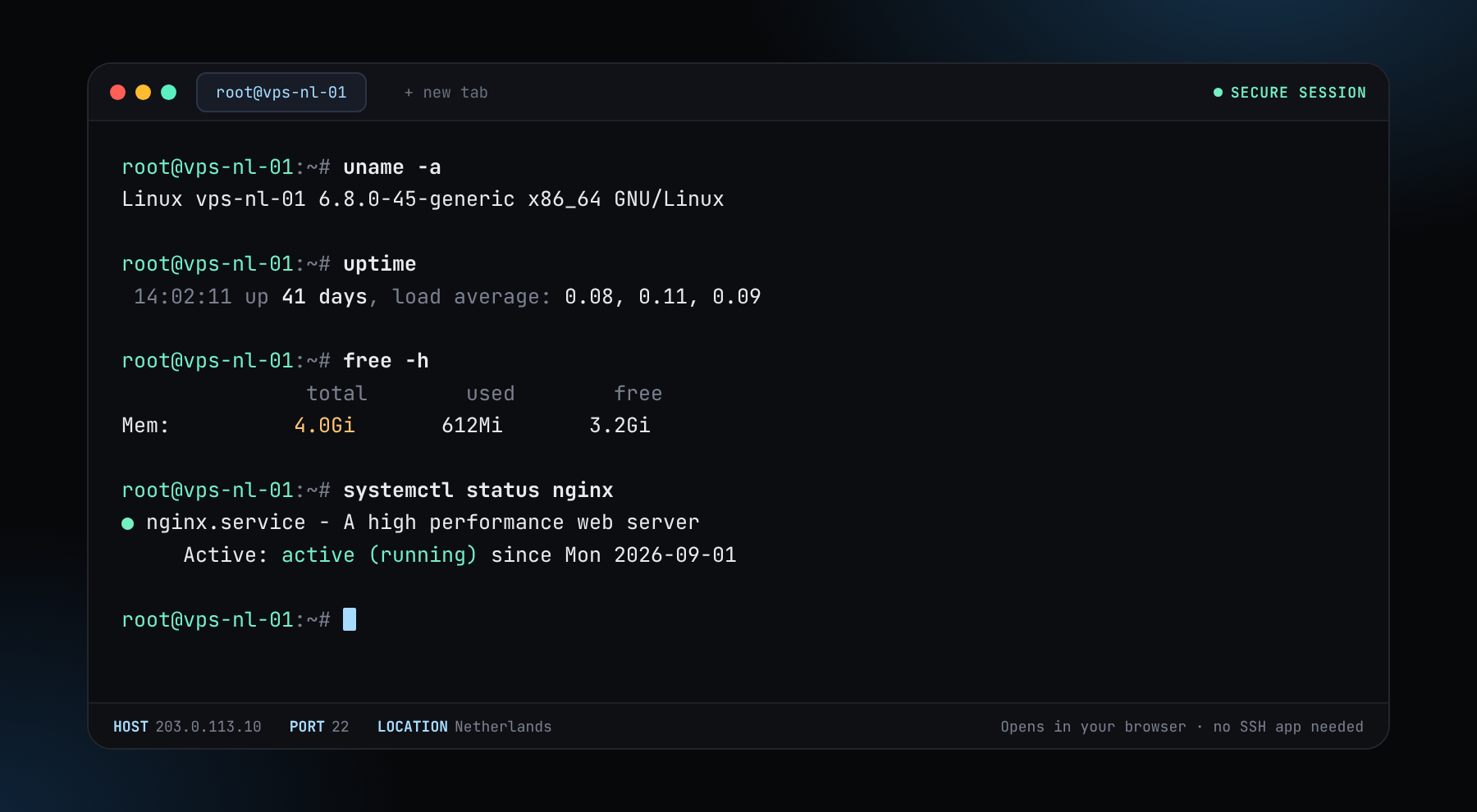
We've got a new update. We now offer our own Web Console. Open the console and type ssh root@your-server-ip to reach any server you own, right from your browser. No SSH app needed.
Litecoin is one of the lighter chains to run yourself, which makes a good first node. A pruned node costs $8.50 a month and a full node with room to grow is $15. Pay in LTC, Bitcoin, Monero or USDT.


Prices are for Romania on a one-month term; a 12-month term takes 50% off.
or $4.25/mo on a 12-month term (−50%)
Full validation with a small disk. Good for a node that only backs your own wallet or payment checkout.
Configure and orderor $7.50/mo on a 12-month term (−50%)
Keeps the whole chain (including MWEB data) with plenty of room.
Configure and orderSources disagree on the chain size, because they measure at different dates and with different options. One guide measured the full chain with txindex at about 150 GB; another, updated in August 2026, quotes about 231 GB. Both recommend an SSD, and the more cautious one says to keep at least 300 GB free. So we size the full build at 400 GB of NVMe, which covers the larger figure with room to grow, and the pruned build at 60 GB.
Litecoin’s initial block download finishes in under a day on NVMe, according to a 2026 setup guide, and takes several times longer on slow disks. The node does constant random reads while it validates, so disk speed shows up directly in sync time.
Litecoin added MimbleWimble Extension Blocks (MWEB), an optional confidential-transaction layer. A current Litecoin Core node validates MWEB data as part of normal operation, so you do not run anything extra. Use the latest Litecoin Core release from the official project and verify the signatures before running it.
Create ~/.litecoin/litecoin.conf as the user that runs the node. Check options against the current Litecoin Core release notes.
server=1
dbcache=2000        # MB of RAM for the cache; speeds up the first sync
maxconnections=40
# rpcbind defaults to localhost: leave it that wayserver=1
dbcache=1000
prune=5000 # MB of block files to keep. The minimum is 550sudo ufw allow 9333/tcp # Litecoin peer port
# never open 9332 (RPC) to the internetPublished figures differ by date and settings: about 150 GB for one 2026 guide measured with txindex and about 231 GB in another updated in August 2026. Budget 300 GB or more. Our full build has 400 GB of NVMe.
Yes. Litecoin Core supports pruning with the prune option, in megabytes, with a minimum of 550. A pruned node validates every block and keeps only recent block files, so a 60 GB disk is plenty.
Under a day on NVMe storage according to a 2026 setup guide, and noticeably longer on slow disks or with little RAM. Raising dbcache helps when the server has the memory.
No. Current Litecoin Core releases handle MWEB as part of validating the chain. Keep the software up to date and verify the download signatures.
No. You create an account with a generated login, top up your balance with LTC, Bitcoin, Monero, USDT or another supported coin, and deploy. See no-KYC VPS hosting.
Port 9333 for peers and 9332 for RPC on mainnet. Open 9333 only if you want inbound peers and keep 9332 on localhost.
Checked 19 October 2026. Chain sizes and software requirements change, so confirm against the source before you order.
Pick a size, pay in LTC or any supported coin, log in as root. No ID, no card.