














The two terms are often used as if they were the same thing. They are not. Offshore hosting means a server in a datacenter outside your home country. Bulletproof hosting is a marketing label for hosts that promise to ignore complaints about almost anything. Understanding the difference helps you avoid the risks of the second.
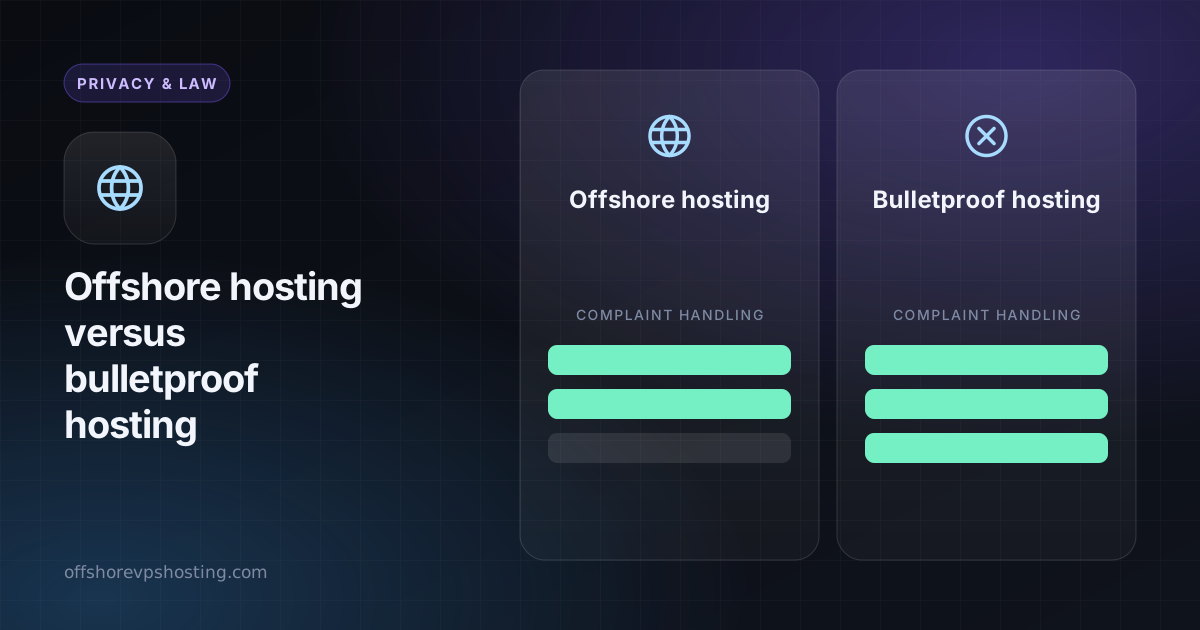
Offshore hosting
- A normal provider in a country with its own laws.
- Has an acceptable use policy and acts on valid legal process from the competent jurisdiction.
- Reviews abuse reports and removes clearly illegal content such as malware, phishing and child exploitation.
- Often accepts crypto and does not require identity documents, but still runs a lawful business.
Bulletproof hosting
- Promises not to act on complaints, in some cases even for clearly abusive content.
- Often prices high because of the risk.
- Attracts spam, botnets and fraud, which gets its IP ranges blocklisted across the internet.
- Can disappear suddenly if law enforcement or upstream providers cut it off.
Why the difference matters to you
- Reputation of the IP address. Shared IP ranges with abusive neighbours get blocked by email providers, CDNs and websites. Your legitimate project suffers.
- Reliability. A host that depends on being unreachable by courts may not be reliable for a business.
- Legal exposure. Using a host that advertises tolerance of crime does not protect you from your own country's law.
Where "DMCA ignored" fits
The DMCA is a United States law. A host in Switzerland or Romania is not bound by its takedown procedure, so a notice is a request, not an order. That is a legal fact about jurisdiction, not a promise to ignore all abuse. Read our guide to what DMCA-ignored hosting really means and see how our DMCA ignored hosting works under local law.
How to tell them apart
- Does the host publish an acceptable use policy that forbids malware, phishing, spam and child exploitation? A legitimate offshore host does.
- Does it explain which country's law applies and how complaints are handled?
- Does it promise to host "anything"? That is a warning sign.
Frequently asked questions
What is the difference between bulletproof and offshore hosting?
Offshore hosting is a server in another jurisdiction that still follows local law. Bulletproof hosting markets itself on ignoring complaints, which carries much higher risk of blocks and shutdowns.
Is bulletproof hosting legal?
The service itself is not always illegal, but it is closely associated with abuse and is blocked by many networks. Most lawful users are better served by ordinary offshore hosting.