














A no-KYC VPS is a virtual private server you can rent without handing over identity documents. There is no passport upload, no selfie and no proof of address. That is the whole definition, and it is narrower than many sellers imply. This guide explains how it works, what it does not do, the risks, and how to choose a provider.
What KYC means in hosting
KYC stands for "know your customer". Banks and exchanges must verify who you are by law. A hosting company has no such legal duty in most countries, so verification is a business choice. Some hosts ask for ID to cut fraud, others only check a payment card, and a no-KYC host asks for neither.
How a no-KYC signup works
- Create an account with a generated login instead of a name, phone number or personal email.
- Add credit with a coin such as Bitcoin, Monero, Litecoin or USDT.
- Pick a plan and location, then deploy. The server is usually ready in minutes.
- Log in over SSH or RDP with credentials the panel gives you.
You can try this flow on our no-KYC VPS page, or see how to top up your balance with crypto.
What a no-KYC provider still knows
No KYC does not mean no data. Even without documents, a host normally sees:
- The IP address you log in from.
- Your payment address and transaction, which is public on most blockchains.
- The traffic and software on your server.
- Any email or contact detail you choose to give.
For the full picture, read how anonymous anonymous hosting really is.
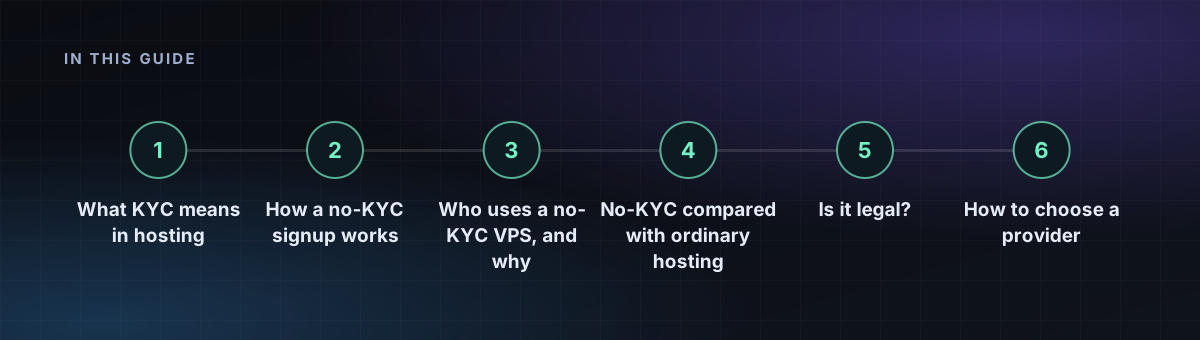
Who uses a no-KYC VPS, and why
- Privacy-minded individuals who do not want a hosting account tied to their passport.
- Developers and small businesses in places where cards and bank transfers are hard to use.
- Journalists, activists and researchers who need to limit exposure. See our page on hosting for journalists and activists.
- Crypto users who want to pay in coins and run nodes or bots.
No-KYC compared with ordinary hosting
| Point | Ordinary host | No-KYC host |
|---|---|---|
| Identity check | Often ID, card or phone | None at signup |
| Payment | Card, PayPal, bank | Mostly crypto |
| Refunds and chargebacks | Easier | Limited, by policy |
| Abuse handling | Account tied to a real person | Handled by the host’s rules |
| Fraud risk to the host | Lower | Higher, so rules are stricter |
The real risks
- Scam providers. With no regulated payment, a fake host can take your coins. Look for a track record, clear terms and real support.
- Account action. Abuse complaints can lead to suspension. No-KYC hosts are not lawless.
- IP reputation. Shared address ranges can carry a bad history that affects email delivery.
- False sense of anonymity. Reusing a username or logging in from home can link you back.
- Limited recourse. If something goes wrong, you rely on the host’s policy, not a card network.
Is it legal?
In most countries, renting a server without ID is legal. What you run must be lawful. See is no-KYC VPS hosting legal for a closer look.
How to choose a provider
- Read the terms of service and acceptable use policy before paying.
- Check the payment options and whether Monero is accepted if privacy matters.
- Look at locations and the law in each country. See how to choose a VPS location.
- Check real specifications: KVM virtualisation, NVMe storage, full root access and port speed.
- Test with a small, short term before committing to a long one.
- Secure the server the moment it is live, with the 15-minute checklist.
Frequently asked questions
What is a no-KYC VPS?
A virtual private server you can rent without uploading identity documents. You sign up with a generated login and usually pay in crypto.
Is a no-KYC VPS anonymous?
It removes the identity paperwork, not every trace. The host still sees your connection IP and payment trail, and your own habits can still identify you.
Is a no-KYC VPS safe?
The server can be as secure as any other if you harden it. The main risks are scam providers, account action over abuse complaints and mistakes that link the account to you.
Which coin is best for a no-KYC VPS?
Monero if privacy matters most. Litecoin and USDT on TRON are cheap and fast. Bitcoin works but is traceable on a public ledger.
Can I run a website or VPN on a no-KYC VPS?
Yes. Websites, VPNs, bots, nodes and self-hosted apps are common uses, as long as they are lawful.