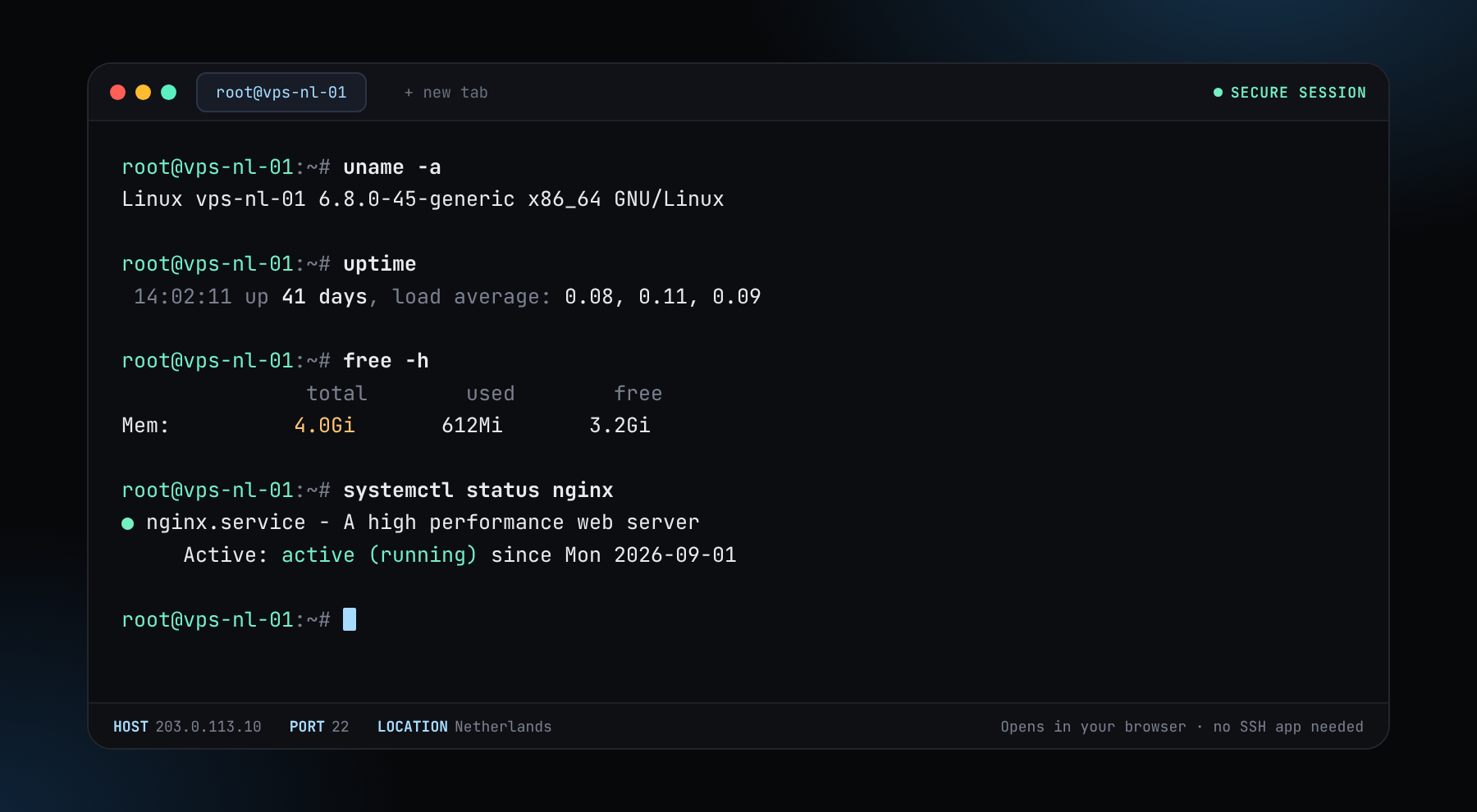
We've got a new update. We now offer our own Web Console. Open the console and type ssh root@your-server-ip to reach any server you own, right from your browser. No SSH app needed.
Choosing a host is one small part of staying safe. This guide is about what a no-KYC server in another country changes for people whose work puts them at risk, and, just as important, what it does not. We are a hosting company, not a security consultancy, so we say where to learn more.
| Concern | What changes | What does not |
|---|---|---|
| The host holding your identity | We never ask for a name, email, ID or phone, so there is no identity file to leak or be subpoenaed | Anything you tell anyone else, and anything linking your payment to you |
| Which courts can reach the server | You choose the country the server sits in. See offshore hosting | Your own government's power over you personally |
| Payment trail | Crypto instead of a card, and Monero for the least traceable on-chain trail | Exchange records if you bought the coin with your identity |
| What the host can see | We state that we do not monitor or log what happens inside your servers | Network-level facts: an IP address is public and a server's existence is visible |
| Losing access | No account recovery, deliberately, because there is nothing to verify against | Nothing: save your login and turn on two-factor authentication |
| Being taken offline | We act on valid legal process and credible abuse reports under our terms | A promise that nothing will ever be removed |
We cannot promise protection from a determined, well-resourced adversary. We can promise to be clear about what we do and do not hold.
A stalker, an employer, a company, a local authority and a national intelligence service need very different protection. Name the one you actually face.
Your identity, your sources, your location, your data, or the fact that a site exists. Each needs different steps.
Decide how bad each failure is, so you spend effort where it matters.
Often that is a separate identity, a strong password manager, two-factor authentication and an encrypted channel, plus a host that does not hold your identity.
No. It can reduce what the provider knows about you. Anonymity depends on much more, including your habits, your devices and your network. We say so plainly.
We cannot assess your situation. A server you control with no identity attached is one useful layer. Treat it as one part of a plan made with a specialist if the risk is serious.
Account records are limited to what runs the service: your balance, orders and support history, plus login device and browser history, never IP addresses. We do not hold a name or ID because we never ask. See the privacy policy.
We respond to valid legal process and credible abuse reports under our terms. See how we handle abuse and legal requests.
It depends on your threat. Our jurisdiction selector and country comparison help you shortlist, and a lawyer should review anything you depend on.
The Electronic Frontier Foundation’s Surveillance Self-Defense site offers guides and a security-plan module. A local legal or press-freedom organisation can advise on your specific case.
Checked 19 October 2026. Chain sizes and software requirements change, so confirm against the source before you order.
Generate a login with no identity attached, pay in crypto and deploy.